
Introduction
The world of digital marketing is changing rapidly. The development of Artificial Intelligence (AI) is forcing businesses to leave traditional marketing behind in order to employ more advanced and effective marketing practices for targeting customers.
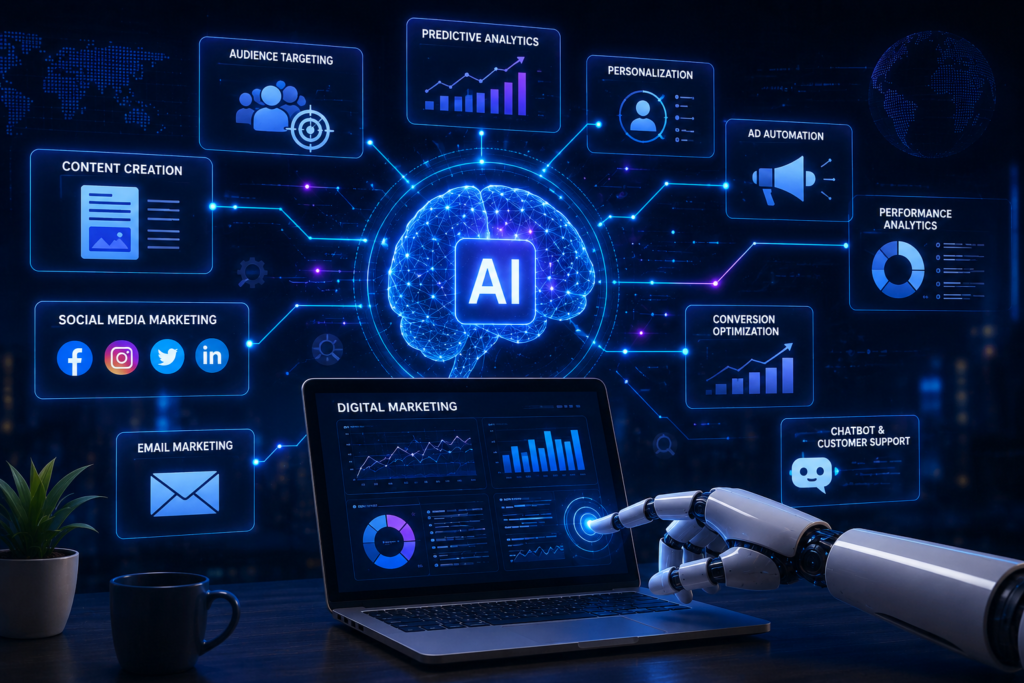
In 2026, AI has stopped being something distant and hypothetical; instead, it has turned into a vital component of digital marketing. AI-driven solutions help brands become more efficient and cost-effective by improving almost all processes of online marketing: content creation, customer interaction, ad campaigns, and so on.
It is important for any business to understand how AI changes digital marketing.
What Is AI-Powered Digital Marketing?
AI-powered digital marketing is the process of planning, performing, analyzing, and improving marketing campaigns with the help of artificial intelligence technologies.
Different from traditional marketing approaches, which are based on extensive research and manual decision-making, AI leverages machine learning, automation, and analysis of data in order to detect consumer behavior patterns and provide consumers with personalized experiences.
Some examples of using AI in digital marketing include:
- AI-generated content creation
- Predictive customer analytics
- Automated advertising campaigns
- Chatbots and virtual assistants
- Personalized recommendations
- Voice search optimization
Why AI Is Becoming Important for Digital Marketing
1. The Better Understanding of Your Clients Due to Data Analysis
Modern clients get into touch with various companies using many platforms each day, leaving a lot of data.
AI tools help to get insights about:
Interests of your clients
Their purchasing patterns
Their online behavior
Their search preferences
It helps to create a campaign targeting the right audience at the right time.
2. AI Is Transforming the Content Marketing Game
Creating the content is one of the most effective methods of digital marketing. But creating a good one takes time and effort.
AI tools are assisting the marketers in:
- Generating blog post topics
- Coming up with social media posts
- Creating email marketing campaigns
- Copywriting ad campaigns
- SEO optimizing
But successful companies know that the AI tool is just the assistant here. Successful marketing uses both.
3. More Effective SEO Due to AI
SEO is constantly developing. Search engines become smarter and now try to understand client intentions better than before.
AI assists businesses in:
- Identifying valuable search trends
- Getting insights about questions of their audience
- Structure optimization
- Recognizing gaps in content
4. AI in Performance Marketing & Advertising
Ad spend platforms are already leveraging AI for campaign optimization.
For instance, Google Ads and Meta Ads use machine learning to:
- Find the best audiences.
- Optimize bidding strategy.
- Place ads better.
- Predict conversion potential.
Thus, businesses get better results from their advertising spends.
5. Personalized Customer Experiences with AI
Today’s customers demand that brands know what they want.
AI offers personalization with:
- Recommendation of products
- Tailored emails
- Personalized web experiences
- Tailored advertisements
For instance, an online store may leverage AI to offer products based on customer searches and past purchases.
Personalization will help to build closer ties between customers and brands.
6. Emergence of AI Chatbots & Automated Customer Support
The demands of customers have evolved. They now want instant responses and round-the-clock support.
With AI chatbots, businesses can:
- Answer customer questions instantly.
- Offer product details.
- Create leads.
- Satisfy customers
So, businesses can give better service without increasing their workloads.
AI Future Trends for Digital Marketing
Here are some future AI trends that will shape the future of digital marketing:
- Generative AI Marketing
The use of AI technology would allow brands to generate videos, images, ads, and customized marketing campaigns quicker than ever before.
- Optimization for Voice Search
With the rise in the usage of smart assistants, businesses will require optimizing their content for conversational search.
- AI-based Marketing Automation
This will assist businesses in managing campaigns, emails, customer journeys, and analytics.
- Predictive Analytics
AI will allow marketers to predict the customer behavior and make smarter decisions before the campaign launch.
How to Prepare Businesses for AI-Driven Marketing?
In order to thrive in the age of AI-driven marketing, businesses will have to:
✅ Understand AI tools
✅ Prioritize quality content creation.
✅ Optimize automation with human creativity.
✅ Analyze customer data
✅ Stay updated with marketing strategies.
AI is not going to replace digital marketers but empower them!
Conclusion
AI-driven digital marketing is changing the way companies engage with and retain their customers. Businesses that embrace the AI marketing strategy early enough will have an edge over their competitors in the digital world.
It’s all about combining technology and creativity for success in digital marketing.
At Marketable Mind, we guide businesses on the current digital marketing trends and assist them in adopting innovative ways of growing digitally.
Frequently Asked Questions (FAQs)
- How does AI impact digital marketing?
AI is assisting marketers to automate marketing processes, analyze consumer behavior, enhance advertising outcomes, and develop personalized marketing approaches.
- Is AI going to replace digital marketers?
No, AI is not going to replace digital marketers. However, AI is going to assist professionals in increasing their efficiency in working.
- What are the most effective AI tools for digital marketing?
The popular AI tools are ChatGPT, Google AI solutions, Canva AI, Jasper, and other AI analytics platforms.
- How does AI impact SEO?
AI assists with researching keywords, optimizing content, analyzing search intent, and enhancing user experience.
- Why should organizations consider AI marketing?
AI marketing allows organizations to be more efficient, cut down expenses, get to know consumers better, and improve campaign effectiveness.