
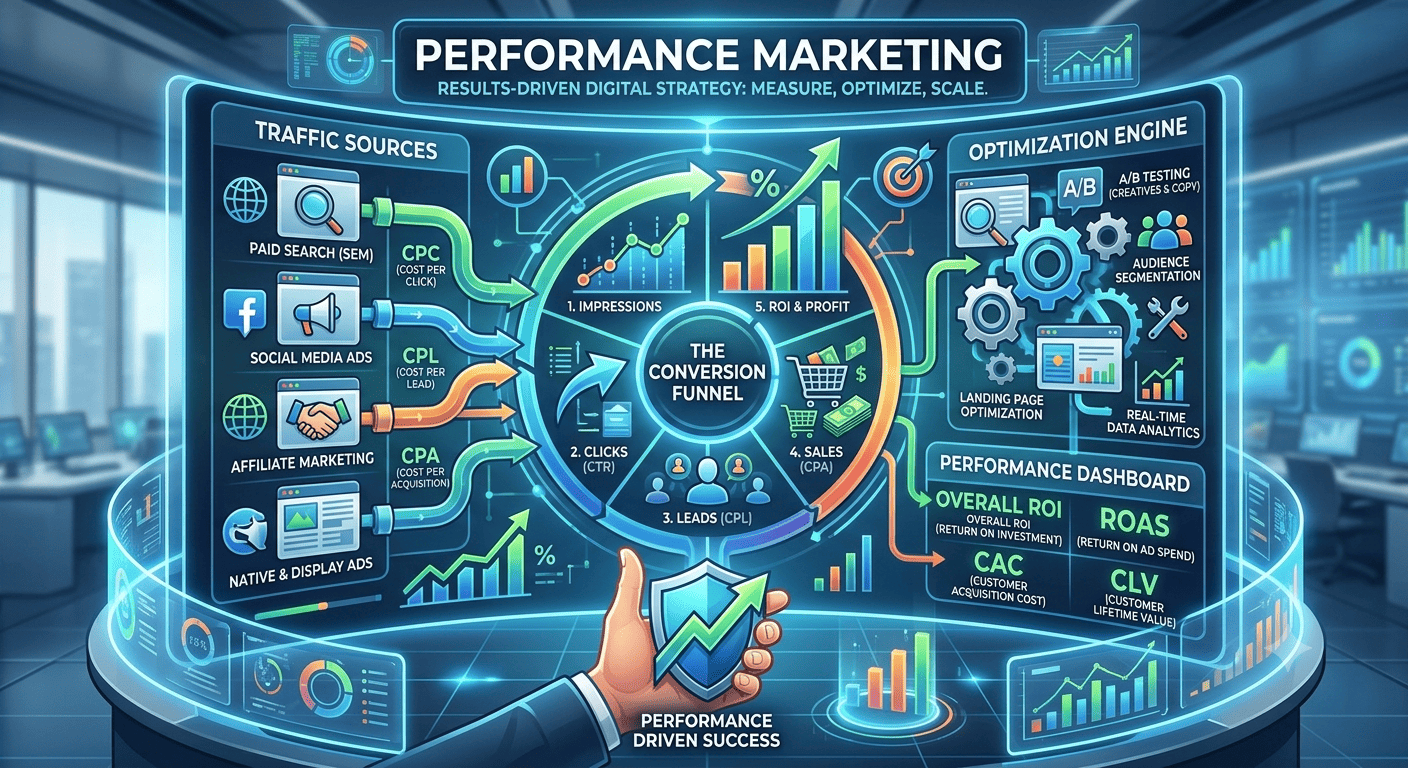
In today’s fast-changing digital world, businesses want marketing strategies that deliver measurable results. That’s where performance marketing comes in. Unlike traditional advertising, where businesses pay for exposure, performance marketing focuses on paying for specific actions such as clicks, leads, sales, or app installs. In 2026, this approach has become one of the most effective ways for businesses to maximize their marketing budget and achieve sustainable growth.
What Is Performance Marketing?
Performance marketing is a digital marketing strategy where advertisers pay only when a desired action is completed. These actions may include website visits, form submissions, product purchases, downloads, or lead generation.
The biggest advantage of performance marketing is accountability. Every campaign can be tracked, measured, and optimized using real-time data, allowing businesses to improve their return on investment (ROI).
Why Performance Marketing Matters in 2026
As digital competition increases, businesses need smarter ways to reach the right audience. Performance marketing helps companies:
- Generate qualified leads
- Increase online sales
- Improve brand visibility
- Track campaign performance in real time
- Reduce unnecessary advertising costs
- Optimize marketing budgets for better ROI
With AI-powered analytics and automation becoming more advanced, marketers can now make faster, data-driven decisions than ever before.
Key Performance Marketing Channels
1. Search Engine Advertising
Search ads allow businesses to appear when users actively search for products or services. Since these users already have buying intent, search advertising often delivers high-quality leads and strong conversion rates.
2. Social Media Advertising
Platforms like Facebook, Instagram, LinkedIn, and TikTok enable businesses to reach highly targeted audiences based on demographics, interests, behaviors, and online activity. These platforms are ideal for both brand awareness and customer acquisition.
3. Display Advertising
Display ads use banners, images, and videos across websites and mobile apps to increase visibility and retarget previous website visitors.
4. Affiliate Marketing
Affiliate marketing allows businesses to partner with publishers or influencers who promote products in exchange for a commission on successful sales or leads.
5. Email Marketing
Personalized email campaigns continue to deliver one of the highest ROIs in digital marketing by nurturing leads and encouraging repeat purchases.
Essential Metrics to Measure
Successful performance marketing depends on tracking the right metrics. Some of the most important KPIs include:
- Cost Per Click (CPC)
- Click-Through Rate (CTR)
- Conversion Rate (CVR)
- Cost Per Acquisition (CPA)
- Return on Ad Spend (ROAS)
- Customer Lifetime Value (CLV)
Monitoring these metrics helps businesses identify which campaigns generate the best results.
The Role of AI in Performance Marketing
Artificial intelligence has transformed performance marketing in 2026. AI tools can:
- Optimize advertising bids automatically
- Predict customer behavior
- Generate ad copy and creative ideas
- Personalize customer experiences
- Improve audience targeting
- Detect campaign trends instantly
By combining automation with data analysis, AI helps marketers make smarter decisions while saving time.
Best Practices for Success
To achieve better performance marketing results, businesses should:
- Clearly define campaign objectives.
- Understand their target audience.
- Create compelling ad creatives.
- Continuously test headlines, images, and landing pages.
- Use audience segmentation for personalized campaigns.
- Monitor campaign performance regularly.
- Invest in high-converting landing pages.
- Optimize campaigns based on real-time analytics.
Small improvements through continuous testing often lead to significant increases in conversions.
Common Mistakes to Avoid
Many businesses waste advertising budgets by making avoidable mistakes, such as:
- Targeting the wrong audience
- Ignoring mobile optimization
- Sending traffic to poorly designed landing pages
- Not tracking conversions accurately
- Stopping campaigns before enough data is collected
- Focusing only on clicks instead of actual business results
Avoiding these mistakes can dramatically improve campaign performance.
Future of Performance Marketing
Performance marketing will continue evolving with AI, predictive analytics, privacy-focused advertising, and first-party data strategies. Businesses that embrace automation while maintaining a customer-focused approach will have a significant competitive advantage.
The future isn’t about spending more on advertising—it’s about spending smarter.
Conclusion
Performance marketing has become an essential strategy for businesses looking to achieve measurable growth in 2026. By combining data-driven decision-making, AI-powered optimization, and continuous campaign testing, companies can generate more leads, increase sales, and maximize their marketing budget. Whether you’re a startup or an established business, investing in performance marketing is one of the smartest ways to achieve long-term digital success.